Somewhere in your forties, the body starts keeping a quieter kind of score. The scale might barely move, but a jar lid feels stubborn, a flight of stairs asks more than it used to, and the shape of your arms and midsection shifts even when your habits have not. That is not your imagination, and it is not a character flaw. It is the biology of perimenopause meeting a decades-long process called muscle loss, and this year the science on how to fight back got a major refresh.
A note before anything else: this article is general information, not medical advice. It is meant to help you have a smarter conversation with your own clinician, not to replace one. Decisions about supplements, protein targets, and exercise, especially if you have any medical condition or take medication, should be made with a doctor who knows your full health picture.
Why Muscle and Bone Loss Accelerate in Midlife
Adults gradually lose muscle mass and strength with age, a process called sarcopenia that typically begins around the thirties and picks up speed later. For women, perimenopause adds an accelerant. As estrogen declines and fluctuates, the hormonal environment that once helped maintain muscle and bone starts to shift against you.
Bone follows a similar and steeper curve. Estrogen is protective for bone, and its decline in the menopause transition is associated with faster bone loss, which is why fracture risk climbs in the years around and after the final period. Muscle and bone are not separate problems, either. Strong muscles pull on bone, and that mechanical load is one of the signals that tells bone to stay dense.
The frustrating part is that muscle loss is quiet. It rarely announces itself until a task that used to be easy becomes hard. The encouraging part is that of all the age-related changes women navigate in midlife, this one is among the most responsive to deliberate action.
If body composition shifts are already on your mind, our companion piece on perimenopause weight gain around the middle covers why fat distribution changes in these years, which is a related but separate piece of the same puzzle.
The 2026 ACSM Guidelines: Consistency Beats Complexity
The timing here is genuinely useful. In April 2026, the American College of Sports Medicine published a new position stand on resistance training for healthy adults, its first major update in roughly 17 years. According to ACSM's own summary of the update, the guidance synthesized 137 systematic reviews representing more than 30,000 participants, making it one of the most comprehensive evidence reviews on strength training assembled to date.
The headline message is refreshingly unfussy. The single most meaningful change, the position stand emphasizes, is moving from no resistance training to any resistance training at all. For most adults, the primary goal is simply regular participation, not chasing a perfect program.
The review also clarified what actually moves the needle versus what is optional. According to ACSM's summary, several things many people obsess over, including training to momentary muscle failure, the choice between machines and free weights, and complex periodization schemes, did not consistently change outcomes for the average healthy adult. What did matter clustered around a few fundamentals: load relative to your capacity, weekly set volume, full range of motion, and genuine effort on each set.
If you want the science-outlet framing alongside the official version, the guidelines were covered in the reporting summarized by Newswise's writeup of the landmark update.
What this means in plain terms. You do not need a fancy gym, a periodized spreadsheet, or the willingness to grind every set to failure. You need to lift something challenging, with good range of motion, a couple of times a week, and to keep showing up. That is a bar most women in perimenopause can clear.
What "Strength Training" Actually Looks Like
The ACSM framework describes different emphases depending on your goal. For building strength, heavier loads (around 80 percent of the most you could lift once) for a small number of sets per exercise; for muscle size, more total weekly volume; for power, moderate loads moved with intent. For general health, the guidance loops back to its core theme: regular participation in any resistance format counts.
For a woman starting out or restarting after years away, that translates to two or three sessions a week hitting the major movement patterns, pushing, pulling, squatting, hinging, and carrying, with a weight that feels genuinely challenging by the last couple of repetitions. Progress comes from gradually asking for a little more over time.
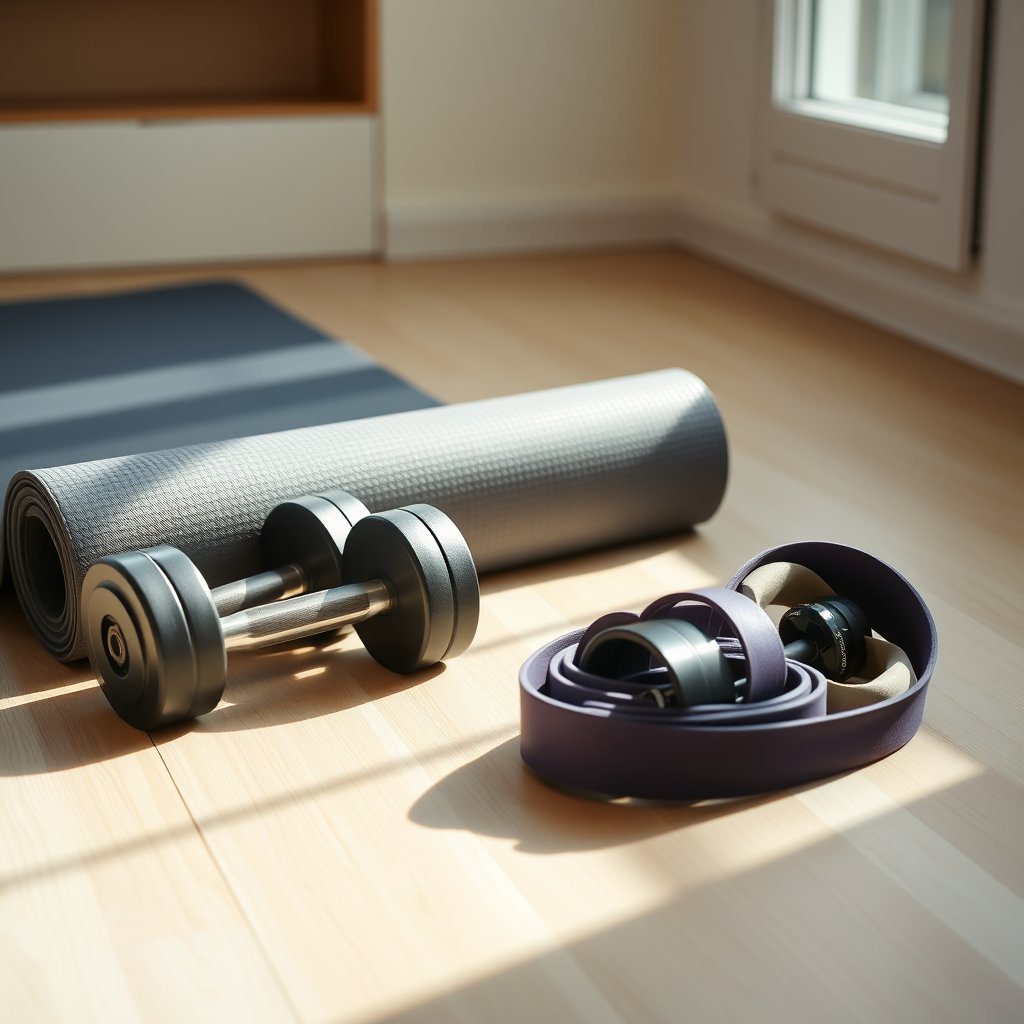
You can build a serious training stimulus at home. A pair of → Shop adjustable dumbbells on Amazon replaces a whole rack and lets you add load as you get stronger, which is the entire point. As an Amazon Associate we earn from qualifying purchases. For joint-friendlier resistance and easy travel workouts, a → Shop resistance bands set on Amazon covers pulling and pressing patterns without heavy equipment. If starting resistance work has you worried about achy joints, our guide to perimenopause joint pain covers why midlife joints get cranky and how to work with them rather than against them.
Protein: The Repair Material
Strength training is the signal. Protein is the raw material your body uses to act on that signal. And here is the part that trips women up: the aging body becomes somewhat resistant to protein's muscle-building message, a phenomenon researchers call anabolic resistance. That means midlife adults often need to be more deliberate about protein than they were at 25, not less.
General guidance for older and active adults tends to land higher than the baseline recommended dietary allowance, which was set to prevent deficiency rather than to optimize muscle. Consensus recommendations from groups such as the PROT-AGE study group and ESPEN expert panels suggest older adults aim for roughly 1.0 to 1.2 grams of protein per kilogram of body weight per day, and that active older adults or those working to preserve muscle may benefit from the higher end of that range, distributed across meals rather than loaded into one.
Two practical principles are worth more than any single number:
- Spread it out. Muscle protein synthesis responds better to protein arriving in meaningful amounts across the day rather than all at dinner. A solid dose at each main meal beats one giant serving.
- Anchor breakfast. Many women eat almost no protein in the morning. Front-loading some protein early is often the easiest single change to make.
Because exact targets depend on your body weight, kidney health, and any medical conditions, treat the numbers above as general framing to discuss with your clinician or a registered dietitian, not a prescription. Anyone with kidney disease in particular should get individualized advice before raising protein intake.
Real food comes first, but a scoop can make hitting your target realistic on busy days. A → Shop whey protein powder for women on Amazon mixed into a morning smoothie is an easy way to anchor that protein-light breakfast. For a wider look at what belongs in a midlife supplement routine and what does not, see our perimenopause supplements starter kit.
Creatine Monohydrate: What the Evidence Shows for Women
Creatine has spent decades pigeonholed as a supplement for young men chasing bench-press numbers. The research on women, and specifically on peri- and postmenopausal women, tells a more interesting story, and it is one of the better-studied supplements in this space.
Creatine monohydrate helps muscle cells regenerate energy quickly during effort. Paired with resistance training, it appears to modestly support the very outcomes that matter most in midlife. A systematic review and meta-analysis of postmenopausal women found that creatine combined with resistance training was associated with small but meaningful improvements in lean mass and strength compared with training plus placebo. Notably, those benefits showed up when creatine was taken at higher doses alongside training; lower doses without resistance training did not produce the same measurable effect. In other words, creatine is a partner to lifting, not a substitute for it.
On dosing, conservatively. The commonly studied and widely used maintenance dose is about 3 to 5 grams of creatine monohydrate per day. Some protocols use a short higher-intake loading phase first, but many people simply take a steady daily maintenance dose without loading and reach the same place over a few weeks. Because the right approach depends on you, treat any specific gram figure here as general information to confirm with your own doctor or pharmacist before starting.
On bone, honestly. The evidence for creatine improving bone is more limited and less consistent than the evidence for muscle and strength. Some studies pairing creatine with resistance training in postmenopausal women have shown promising signals at certain bone sites, but this is an area where the science is still developing, and creatine should not be treated as a bone treatment. Resistance training itself remains the more established lever for bone.
On safety. In healthy adults, creatine monohydrate is one of the more extensively studied supplements and is generally considered safe at typical doses. That said, it is not for everyone. If you have kidney disease, are pregnant or breastfeeding, or take medications that affect kidney function, you should talk to your clinician before using it. Choose plain creatine monohydrate rather than exotic, more expensive "advanced" forms, since monohydrate is the form the research actually supports. A → Shop creatine monohydrate powder on Amazon in an unflavored micronized form mixes easily into water or your morning protein shake.
Putting the Playbook Together
None of these three levers works as well alone as they do together. The pattern that the evidence keeps pointing toward looks like this:
- Lift regularly. Two or three resistance sessions a week, challenging weight, full range of motion, showing up consistently. This is the foundation the ACSM update reinforces, and it is the single most important habit.
- Feed the work. Adequate, evenly distributed protein gives your body the material to rebuild. Aim to make breakfast less of a protein desert.
- Consider creatine as a supporting player. For many women who are already training, a modest daily dose of creatine monohydrate is a low-cost, well-studied addition, once you have cleared it with your clinician.
What ties them together is time. Muscle and bone respond to consistent stress and adequate nutrition, but they respond over months and years, not days. The women who see the biggest changes are rarely the ones with the most elaborate programs. They are the ones who kept lifting, kept eating enough protein, and let the slow biology do its work.
The Bottom Line
Muscle and bone loss accelerate in perimenopause, but this is one of the most modifiable challenges of midlife. The 2026 ACSM position stand delivered a clear, encouraging message: any resistance training beats none, and consistency matters more than complexity. Layer adequate, well-distributed protein on top of that training, and consider creatine monohydrate as a well-studied supporting supplement, and you have a playbook grounded in real evidence rather than hype.
To repeat the disclaimer, because it matters most here: everything above is general information, not medical advice. Protein targets, supplement choices, and exercise programs should be individualized, especially if you have kidney disease, osteoporosis, cardiovascular concerns, or take medication. Bring these ideas to a clinician who knows your history. The strongest version of this plan is the one built for your actual body.
As an Amazon Associate we earn from qualifying purchases. This article contains affiliate links; if you buy through them we may earn a small commission at no additional cost to you.